Quayside Proving Grounds: Ten UK Ports Testing Autonomous Cargo Handling
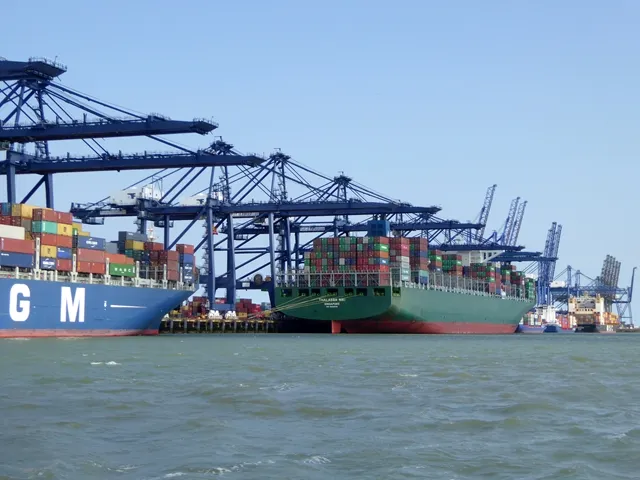
Photo: Oliver Dixon , CC BY-SA 2.0, via Wikimedia Commons
Autonomous cargo handling is often presented as a clean break with the past: driverless vehicles, remote cranes and sensor-rich quays replacing manual routines. The reality at UK ports is messier and more interesting. Automation arrives beside existing operations, not instead of them, and the hard work lies in integration, safety assurance and the gradual transfer of skills. The ten ports below are not a league table. They are a set of proving grounds where the practical questions are being worked through.
1. Teesport, Middlesbrough
Teesport has been examining remote and semi-automated container handling as part of a wider push to raise throughput without expanding the quay footprint. The integration challenge is familiar: a terminal operating system that was designed around manual equipment moves must now reconcile live position data from automated vehicles. The port also has to assure safe mixed traffic between autonomous units and conventional plant. That is less a software problem than an operating-model problem, and it requires the safety case to be written alongside the control system rather than after it.
2. Port of Felixstowe, Suffolk
Felixstowe is one of the UK's most established sites for remote-controlled crane operations and automated container handling. Its advantage is scale, but scale also raises the cost of change. Legacy terminal systems must feed a growing number of automated subsystems without creating a single point of failure. The port's challenge is to keep the older estate coherent while adding new automation layers, and to ensure that engineers can diagnose faults across systems supplied by different vendors with different data models.
3. London Gateway, Essex
London Gateway has been designed with a high degree of automation from the outset, including remote-controlled cranes and automated stacking. The remaining integration work tends to sit at the edges: road gate systems, rail connections and customer-facing data flows that were not part of the original automated core. Those edges matter because they determine whether automation delivers a faster end-to-end journey or simply moves the queue elsewhere. The port's experience illustrates a useful rule: automate the quay first, but measure the whole chain.
4. Port of Southampton, Hampshire
Southampton handles a mix of container, vehicle and bulk traffic, which makes uniform automation difficult. Trials of remote crane operation and sensor-rich quay systems have to coexist with vehicle handling and other manual processes. The integration challenge is spatial as well as digital. Automated equipment needs clear lanes, reliable positioning and a safety case that accounts for people moving through a working port. The port's environment rewards incremental automation rather than grand redesign.
5. Port of Liverpool, Merseyside
Liverpool's container terminal has invested in semi-automated equipment and remote operations, with straddle carriers and cranes increasingly supported by digital positioning and scheduling systems. The difficult part is the handover between automated and manual modes. When a carrier switches to manual control for an exception, the terminal system must retain a coherent record of what happened and why. Without that record, the automation is hard to audit and harder to improve. Liverpool's work highlights the value of exception logging as a first-class requirement.
6. Bristol Port, Avonmouth
Bristol Port's traffic is weighted towards bulk and general cargo, where automation often means sensor-enabled cranes, remote monitoring and assisted scheduling rather than fully driverless vehicles. The integration challenge is data quality. Bulk operations generate less structured data than container terminals, and legacy weighbridge, conveyor and stockpile systems may not expose the signals that automation needs. The port's experience suggests that automation in bulk environments begins with instrumentation, not with vehicles.
7. Port of Immingham, Lincolnshire
Immingham handles large volumes of bulk and ro-ro traffic, and automation there tends to focus on remote crane operation, vehicle booking systems and quay sensors. The port's challenge is the interface between automated cargo handling and road haulage. If a remote crane is ready but the truck is not, automation does not create throughput. Integrating terminal systems with haulier booking platforms and gate processes is unglamorous but decisive. It also requires agreement on data standards across companies that do not normally share operational data.
8. Grangemouth, Forth
Grangemouth's mix of bulk liquids, containers and general cargo makes it a useful test bed for modular automation. Remote monitoring and semi-automated handling can be introduced in one part of the estate without requiring the whole port to change at once. The integration challenge is governance: who owns the data from a sensor-rich quay, and who acts when a signal suggests a problem? Automation that produces alerts without a clear response pathway quickly becomes noise. Grangemouth's lesson is that operational ownership must be assigned before the sensors are switched on.
9. Port of Milford Haven, Pembrokeshire
Milford Haven is an energy port with large, hazardous cargo flows, where automation is more about remote monitoring, inspection and safety assurance than driverless movement. Sensor-rich systems can track mooring loads, vessel movements and structural conditions, but the port must integrate those signals with emergency planning and regulatory reporting. The challenge is assurance: a sensor reading is not a safety case. The port's work shows how automation in high-consequence environments depends on validation, calibration and a clear audit trail.
10. Belfast Harbour, Northern Ireland
Belfast Harbour has been developing digital and automated systems across container, ferry and offshore wind operations. The integration challenge is the port community system: a single automated quay must exchange data with shipping lines, hauliers, customs and service providers. That requires common data definitions and a willingness to expose operational events in near real time. Belfast's experience points to a broader truth: port automation succeeds when the port is treated as a data-sharing organisation, not just a collection of machines.
What the ten sites have in common
None of these ports is removing human judgement from cargo handling. They are redistributing it. Remote crane operators, automation engineers, safety assurance specialists and data stewards are becoming as important as traditional plant operators. The ports that make automation work will be those that treat integration, safety cases and workforce transition as core engineering disciplines rather than as procurement afterthoughts. The quayside is becoming a systems lab, and the lessons are being written in mixed traffic, legacy interfaces and exception logs.