Audible Evidence: Why UK Drone Corridors Need a Noise Budget Before Routine Flight
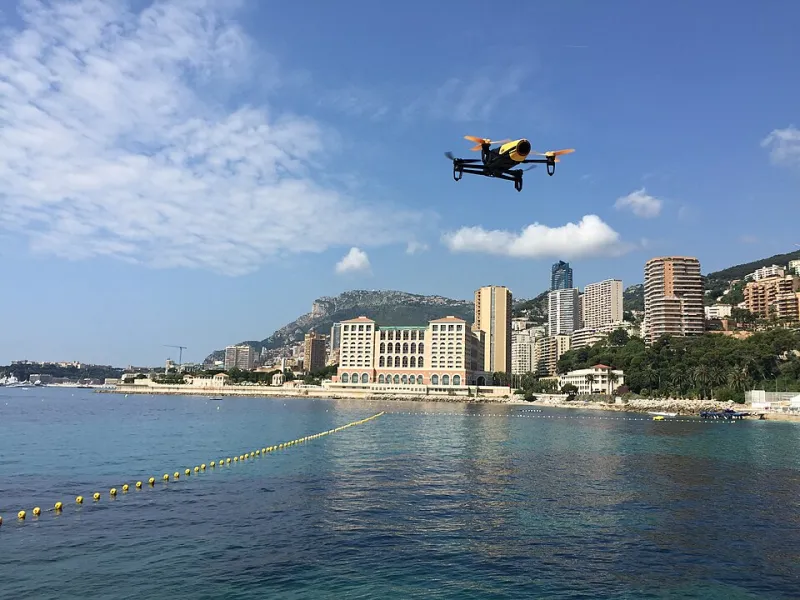
Photo: Halftermeyer, CC BY-SA 4.0, via Wikimedia Commons
In the race to prove that uncrewed aircraft can fly routinely beyond visual line of sight, the safety case has become the central document. It is rigorous about airspace, detect-and-avoid, link loss and emergency containment. It is often much thinner on what residents will hear. As UK trials move toward routine operations in 2026, that gap is becoming a governance problem rather than a technical footnote.
Noise is not a secondary concern for a corridor that passes over homes, schools, hospitals or industrial estates. It is part of the operating envelope. A route that is safe but acoustically unacceptable will not scale, because the objections will arrive through planning committees, environmental health departments and local media long before they arrive through the regulator. The sector needs an acoustic baseline before take-off, not after the first complaint.
Safety Is Not the Same as Amenity
A safety case asks whether an aircraft can fail without harming people. A noise assessment asks whether a service can operate without degrading the places it flies over. The two questions are related, but they are not interchangeable. A drone may meet every airworthiness and containment requirement while producing a sound signature that is intrusive at 7am on a suburban street.
That distinction matters because the UK’s regulatory architecture treats aviation safety and environmental amenity through different instruments. The Civil Aviation Authority (CAA) is the focus for airspace and operating approvals. Local planning authorities, environmental health teams and devolved bodies hold much of the levers on land use and nuisance. A corridor that is approved in one system and contested in the other is an unstable piece of infrastructure.
What a Baseline Must Record
An acoustic baseline is not a single number attached to a trial site. It is a record of the existing sound environment against which future operations can be judged. For a drone corridor, that record should be spatial, temporal and spectral.
Spatially, it needs a grid of receptor points rather than one microphone near the launch site. Corridors are linear pieces of infrastructure, and noise exposure will vary along the route, at turning points and near descent or hover phases. Temporally, it should capture day, evening and night conditions, weekday and weekend patterns, and seasonal differences in foliage, ground cover and background activity. Spectrally, it should record more than an overall level: one-third-octave data, tonality, event duration and the rate of events all matter for how sound is perceived.
A useful baseline also records the operating variables that will change the noise: aircraft type, altitude, speed, payload, flight mode and weather. Without those covariates, a monitoring dataset becomes a list of levels rather than an explanation.
The metrics should be chosen before monitoring begins. Equivalent continuous levels such as LAeq,T are useful for average exposure, but they can hide the short, sharp events that make drone noise noticeable. Maximum levels, event counts and percentile statistics should sit alongside them. Where tonal components are present, they should be identified explicitly rather than averaged away.
The Budget, Not Just the Baseline
A baseline describes the past. A noise budget governs the future. The idea is borrowed from other areas of environmental management: set a total acceptable exposure for a corridor, allocate it across operators and time windows, and require evidence that the allocation is respected.
That budget could be expressed as a cap on event counts at sensitive receptors, a limit on maximum levels during defined hours, or a combination of both. It could vary by receptor sensitivity, with tighter limits near schools and hospitals and more permissive limits over industrial land. It should be published, because a budget that exists only inside an operator’s spreadsheet is not a governance instrument.
The budget also forces decisions that trial-by-trial assessment tends to defer. If three logistics operators want to use the same corridor, who gets the morning slot? If a new route increases the event rate at one village, does it draw down the same allowance as an existing operator? A budget makes those trade-offs visible. It turns noise from a post-hoc complaint into a design constraint.
Monitoring After Launch
A baseline without a monitoring obligation is a snapshot that ages badly. Corridors are not static: operators change, aircraft types evolve, flight frequencies rise and routes are adjusted. The acoustic evidence should evolve with them.
A workable regime would require calibrated monitoring at a set of representative receptors, with data published at regular intervals and a clear method for handling weather and background noise. It would also require trigger thresholds. If measured levels exceed the budget, or if event counts rise beyond the allocated allowance, there should be a defined response: route adjustment, altitude change, time-of-day restrictions, fleet substitution or a temporary pause while the cause is investigated.
That sounds bureaucratic until it is compared with the alternative. Without triggers, the first serious evidence of a noise problem often arrives as a formal complaint or a freedom-of-information request. By then, the operator is defending a service rather than adjusting one.
Making It UK-Real
The UK does not need a new regulator to make this work. It needs the existing actors to ask for the right evidence at the right moment. Planning conditions can require an acoustic baseline and a monitoring plan before a corridor is consented. Procurement can make noise reporting a contractual deliverable rather than a voluntary gesture. Environmental health teams can be involved at the design stage, not only after a nuisance complaint.
There is useful discipline in established UK noise assessment practice, including the principles behind BS 4142 for industrial and commercial sound. A drone is not a fixed industrial source, and the assessment should not pretend otherwise, but the habit of comparing source levels with background conditions is sound. The same is true of the event-based thinking used in other transport noise contexts: what matters is not only the average, but how often, how loud and at what time.
The CAA’s beyond-visual-line-of-sight work has given the UK a credible pathway for routine operations. The missing layer is community evidence. A published baseline, a corridor noise budget and a monitoring duty would not answer every objection, but they would give planners, operators and residents a shared factual language. That is a better foundation for scale than reassurance delivered one trial at a time.
The Cost of Waiting
Community consent is an asset that depreciates quickly. A corridor that begins with unexplained overflights and no public sound record will struggle to recover trust, even if later data proves benign. A corridor that begins with a baseline, a budget and a commitment to publish will still face disagreement, but it will face it with evidence.
The UK’s drone corridors should not be designed as safety cases with an acoustic annex bolted on. They should be designed as environmental systems from the start. Before routine flight, the sector needs to know what the corridor sounds like now, what it is allowed to sound like later, and who is responsible for proving the difference.